Optimizing Concrete Flooring And Framing Systems

Abstract
The construction industry is a vital contributor to global economic development: Global economy of construction industry was $8.2 trillion in 2022 and is projected to reach $14.4 trillion in 2030 (Statista, 2022).

However, the construction industry accounts for 38% of global emissions (World Economic Forum, 2021).
Size of the global construction market from 2020 2030 (in trillion U.S. dollars)
In response to the industry's evolving priorities:
The Aim of this research is to reduce the carbon emissions, cost and time of construction by optimizing concrete flooring and framing systems in multistory residential buildings.
Objectives:
-
Review Concrete Systems: Explore and explain common concrete flooring and framing systems, detailing their pros and cons.
-
Assess System Impacts: Identify effects of different systems on cost, project timeline, and carbon footprint.
-
Implement Optimal Systems: Apply best systems in a Qatar mid-rise case study, using Robot Structural Analysis.
-
Evaluate Concrete Usage: Examine findings on reinforced concrete volume, assessing implications for cost, time, & environment.
Using Concept V4: Cost and Carbon tool:
For an 8-story building, different slab systems were compared in-terms of cost & carbon for the following plan:

Results: Two-way slab was the optimal system. With a superstructure cost of 94 £/m2 and carbon emission of 62 KgCO2/m2 :

Two-way slab
Flat slab
One-way slab
Post-tension slab
Hollow-core slab
Ribbed slab


Background
From literature review, Each slab system has its own economical spans, so the economity of a system depends on the type of the structure and the span required:
Different Slab Systems


Economical Span Of Slab Systems


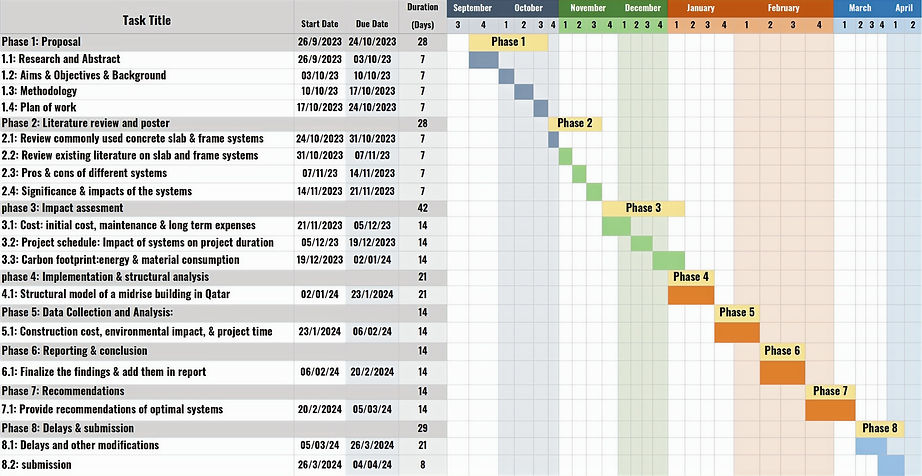
Methodology
1.Literature Review:
The review evaluates concrete slab & frame system pros & cons from scholarly articles.
2.Impact Assessment:
Assess impacts of diverse slab and framing systems on cost, time, & carbon footprint.
3.Implementation & Structural Analysis:
4.Data Collection & Analysis:
5.Reporting & Conclusion:
6.Recommendation:
Apply optimal systems in Qatar mid-rise buildings using Robot Structural Analysis.
Analyze mid-rise project data for chosen systems' impact on cost, timeline, & carbon footprint.
Compile study results, draw conclusions on cost, time, & sustainability of chosen systems.
Conclude with recommendations for future concrete construction decisions in Qatar & beyond.
Cost of Some Slab Systems In Qatar
Flat Slab, One-Way Slab, & Two-Way Slabs:
- The Formwork + steel reinforcement and installation = 300 Qar per cubic meter
- Concrete per cubic meter = 300 Qar
Post Tensioning:
- Formwork = 200 Qar per cubic meter
- Tension rods with installation = 270 Qar per cubic meter
- Concrete per cubic meter = 300 Qar
Precast Units (Hollow-Core) slab:
- Each meter square costs 170 Qar
Note: Those costs are estimated costs.

Case Study
The case study phase is a practical application where optimal concrete flooring and framing systems will be implemented in a six-story residential building located in Qatar. The architectural plan encompasses a basement, ground floor, and four typical floors.
Informed by insights from the literature review and impact assessment, the focus is on identifying the most cost-effective slabs and framing system tailored to the provided architectural plans.
Utilizing advanced software, such as Robot Structural Analysis, a thorough analysis of the structural integrity and performance of the selected systems will be conducted, simulating real-world conditions.
A key aspect of this phase involves comprehensive data collection and analysis, specifically focusing on cost, time, and carbon emissions associated with different systems.
The ultimate goal is to discern and recommend the optimal slab and framing system for the construction of a concrete multistory residential building, aligning with efficiency, structural integrity, and sustainability considerations.
Expected result
The following table shows the expected difference of superstructure cost and carbon emissions in percentage between different slab systems:
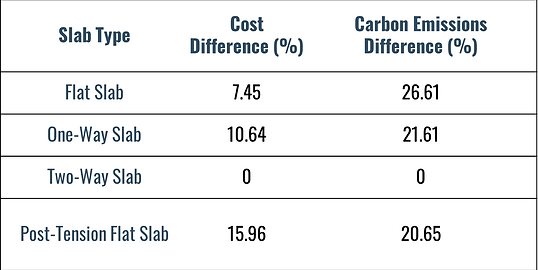
These findings indicate that the optimal choice for mid-rise buildings is the two-way slab, offering a balance of cost-effectiveness and environmental friendliness.
It is expected that using a post tension flat slab over two-way slab will increase superstructure cost by around 16% and carbon emissions by 20.65%.
Plan Of Work